Where Ortega is, and why the drive is what it is
Ortega is a peninsula on the west bank of the St. Johns River. From our base at 164 Johns Glen Dr in Fruit Cove that is 17 road miles and about 29 minutes, out across the Buckman Bridge and north on Roosevelt Boulevard. The crow-flies number is a good deal shorter, but there are only so many bridges in this metro.
Old Ortega, Ortega Forest and Venetia are three different things
Development began in 1909, when the Ortega Company — John N.C. Stockton and Charles C. Bettes — laid the place out to a design by Henry J. Klutho. Old Ortega, east of Roosevelt Boulevard, was added to the National Register of Historic Places in 2004 with 597 historic buildings across roughly 4,500 acres, in Mediterranean Revival, Tudor and Craftsman styles concentrated along Ortega Boulevard. Ortega Forest sits west of Roosevelt. Venetia was founded in 1925 by Col. Raymond C. Turck on 500 acres. The Florida Yacht Club, organized in 1876, and Timuquana Country Club anchor the social side.
NeighborhoodScout puts Ortega in the top 15 percent of highest-income neighborhoods in America. The practical consequence for us is a lot of very good appliances installed into houses that predate them by eighty or ninety years.
The retrofit problem
An Old Ortega kitchen was not designed for what is now in it. Cabinet openings run to legacy 30-inch widths. Interior doorways are narrow enough that a column refrigerator has to come in stripped — doors and hinges off, the unit walked in as a cabinet and rebuilt in place. Sub-Zero states outright that Designer series units cannot be standard-installed; they are a cabinetry job.
Then there is the floor. Built-ins run well past 700 pounds loaded, and framing from 1915 was not calculated for a point load like that. When we find a door that will not seal in a house of this age, the first check is not the gasket — it is whether the cabinet is still level. Deflection under the unit throws the door out, the seal fails, and you get frost on the back wall and a compartment drifting warm. Replacing the gasket without fixing the level just buys you a few months.
The other retrofit problem is the wiring
A modern luxury kitchen is an electrical load that houses from 1909 to the 1930s were never designed to carry. Built-in refrigeration generally expects its own circuit. So do an undercounter wine unit, a beverage centre and an ice maker, each of which is a compressor starting and stopping on its own schedule. A 48-inch dual-fuel range wants a 240-volt supply of its own, a steam oven and a built-in coffee system each want a circuit, and the hood above the range is a motor load too.
Houses of this age have generally been rewired at least once and extended several times, and the extensions are where the trouble lives. What we find, repeatedly, is two or three appliances sharing a circuit that was adequate when it carried one, a receptacle behind a built-in that nobody can reach without pulling the unit, or an outlet that tests fine at rest and sags the moment a compressor tries to start.
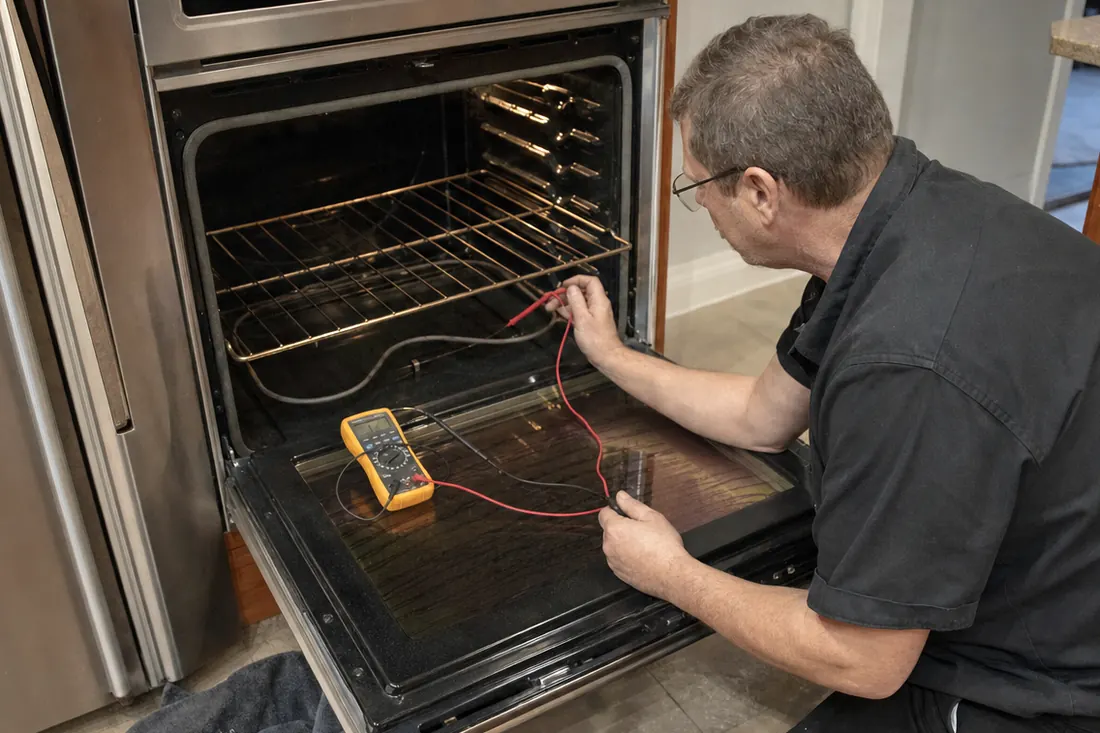
That matters because the symptoms imitate appliance faults precisely. A unit that resets itself, a board that fails twice in a year, an ice maker that “turns itself off”, a range that trips only when the oven and the cooktop are both running - all of those are worth checking at the supply before anything is condemned. It costs a few minutes with a meter and it occasionally saves a control board that was never broken.
When the fault genuinely is in the appliance, we say so and quote it. When it is the circuit feeding it, we say that too, and that is an electrician’s job rather than ours.
Dock kitchens, humidity and storms
Ortega’s frontage means outdoor kitchens: undercounter refrigeration, ice machines and beverage centers sitting outdoors through an average relative humidity near 75 percent, peaking around 81 percent in August. Those condensers load up with debris faster and the units run longer duty cycles, so plan on cleaning them more often than an indoor unit, not less.
Ortega also takes water when surge runs up the St. Johns from a storm whose center never comes near Duval County — which is exactly how Matthew in 2016 and Irma in 2017 did their damage. Water at the compressor deck or the control board is a component replacement, not a dry-out.
Working with us
We are an independent appliance repair company. Technicians hold EPA Section 608 certification and we fit genuine OEM parts. The diagnostic fee is $80, flat, credited toward the repair when you approve it. Monday to Friday 8am–6pm, Saturday 9am–4pm. Call +1 (904) 977-8701.