PLUMBED · RESERVOIR · BURR GRINDER

Built-In Coffee System Repair

Brew unit seals, grinder burrs, pumps, flow meters and boiler faults in plumbed and reservoir-fed built-in espresso systems.

40-mile radius$129 diagnostic90-day labor warranty

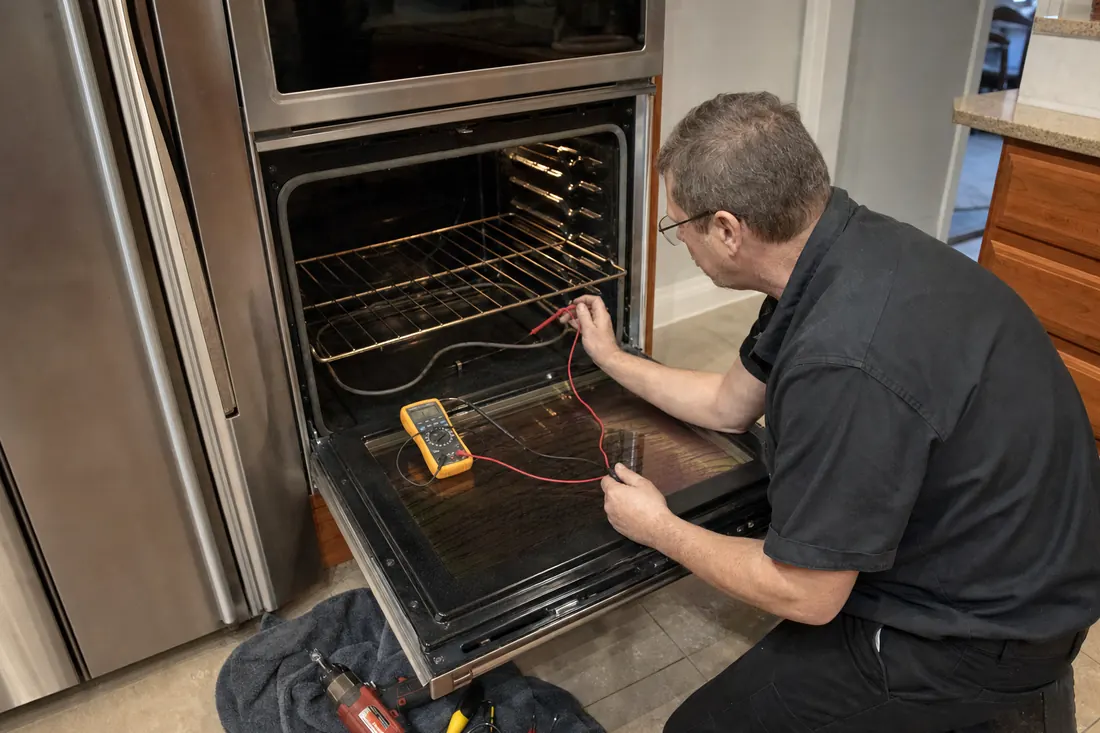
Technician testing the bake element of an open double wall oven with a multimeter, tools on a towel on the tile floor in frame - Built-In Coffee System Repair

Sound familiar?

What we get called out for

  • The coffee comes out lukewarm
  • Only a dribble comes out, or nothing at all
  • It grinds but never brews
  • Water is leaking into the drip tray or down the cabinet
  • The grinder is screaming, rattling or jammed
  • It asks to be descaled constantly
  • The milk frother pushes out foam with no milk
  • The machine says fill the reservoir when the reservoir is full
  • It runs a cycle then shuts down with an error

What usually fails

A built-in coffee system is a small pressurized water appliance with a grinder attached, and it fails like one.

The brew unit is the heart of it. It is a moving assembly that clamps a puck of ground coffee, holds around nine bars while water passes through it, then ejects the puck into a drawer. It runs that cycle several times a day on seals that are exposed to hot water, coffee oil and pressure. When those seals swell or take a set, water escapes past the puck instead of through it. The result is weak coffee, a wet grounds drawer, water in the drip tray that nobody poured there, and eventually a piston that will not travel and a cycle that stalls with the grounds still inside.

Scale is the second cause and it affects everything downstream of the water inlet. It builds on the hottest surface first — the thermoblock or the boiler wall — where it acts as insulation and drops cup temperature. Then it narrows the flow meter, which is a tiny impeller the control uses to count water volume. A scaled meter under-counts, so the machine cuts the shot short or runs long, and neither behavior looks like a water problem to the owner.

On the grinder side, burrs are consumables. They dull gradually, so the grind coarsens, extraction drops and the coffee goes thin over months rather than overnight. Oily dark-roast beans compound it by gumming the chute. The dramatic version is a stone or a bean fragment jammed between the burrs, which stalls the motor and, on some designs, trips a thermal cutout that makes the machine look dead.

Then the water side: vibration pumps that lose pressure, three-way solenoid valves that will not vent brew pressure, inlet valves and reservoir seals that let water into the cabinet rather than into the machine. Milk circuits fail one way only — dried protein in the venturi and lines.

How we diagnose it

We brew. Cup temperature, shot volume and the time the pump runs tell you most of what you need before anything comes apart. A short, fast shot at correct temperature is a grind and burr problem. A full-volume shot at low temperature is scale or an element. A cycle that grinds and then stalls is the brew unit or the valve.

Then the brew unit comes out and gets inspected: piston travel, seal condition, scoring on the chamber wall, and how the coffee is packing. Grind is checked at the burrs rather than judged by eye. We also check the water setting the machine was programmed with, because that value is what the descale counter is calculated from, and a machine left on its factory default will ask to be descaled far later than it should.

What the repair involves

Built-in systems sit in a cabinet cut-out with power behind them and, on plumbed models, a water line. In-home work covers the majority of it: descaling the boiler and lines, stripping and resealing the brew unit, replacing burrs, cleaning the milk circuit properly rather than running the rinse program. Pump, valve and element work on some designs means the unit comes out onto the bench, and we say which before starting.

We use genuine OEM seal kits and burrs. Coffee machine seals are dimensionally fussy, and a nearly-right o-ring gives you an intermittent leak that is far harder to find than the original fault.

When it is worth repairing

Almost always, and for a reason specific to built-ins. A plumbed-in coffee system shares its cut-out and its trim with the ovens beside it. Replacing it is not a matter of buying a new machine — it is matching the column, and often the panel, which is why owners keep these units for a very long time.

The parts that fail are the parts designed to be replaced: seals, burrs, pumps, valves. The exception, as always, is a discontinued control board with no supply. We check availability against your data plate before recommending anything, and if the answer is no we say so.

Independent service, based in Fruit Cove and covering St. Johns and Duval County. Mon–Fri 8am–6pm, Sat 9am–4pm. Call +1 (904) 977-8701.
Brands

Coffee Systems we service

Try this first

Guides for this appliance

Some of it you can genuinely sort out yourself in ten minutes. We would rather you did than paid us to.

Coffee Systems: common questions

My built-in coffee machine only makes lukewarm coffee. What causes that?

Three things, in order of likelihood — scale insulating the thermoblock or boiler so it cannot transfer heat, a failing heating element, or a brew unit leaking hot water internally so the shot arrives diluted and cool. Cup temperature is easy to measure, so this is one of the faster diagnoses.

It grinds the beans but no coffee comes out. Where did the grounds go?

Into the brew unit, which then failed to complete its cycle. Usually the brew unit piston is seized or its seals have swollen, or the three-way valve is not releasing pressure so the puck never gets pushed to the grounds drawer. Stop running cycles at that point. Each one packs more coffee into a chamber that is not clearing.

How often should a built-in coffee system be serviced?

Descale on the interval the machine prompts, which is calculated from the water setting it was given at installation. Beyond that, a full strip and reseal of the brew unit every couple of years on a machine making several cups a day keeps the seals ahead of failure. Most of the dead machines we see were never opened, only descaled.

What is the flow meter, and why does it change the shot?

It is a small impeller in the water path that the control uses to count volume, because the machine has no other way of knowing how much water it has pushed through the puck. When it is restricted it under-counts, so the control keeps the pump running or cuts it short, and the shot arrives long or short with no obvious cause. It is one of the first things we check when the volume is wrong but the temperature is right.

Why does the milk system foam air instead of milk?

Dried milk protein in the venturi or the milk line, almost every time. The frothing circuit draws milk by suction, and a partial blockage lets it pull air freely while the milk stays put. Running the daily milk rinse the machine offers prevents it. Once it has set, the circuit needs to come apart and be cleaned properly.

Do you repair coffee systems in the home or take them away?

Most work is done in the home, including descaling, brew unit resealing, burr replacement and milk circuit cleaning. Pump, valve and element replacement on some designs needs the unit out of its cabinet on the bench, and we tell you which one applies before we start rather than after.

Customer feedback

After a coffee systems visit

Rated 4.8 out of 5 across 72 customer reviews. These three describe this job in particular.

Malcolm B.May 9, 2026

The steam wand had almost no pressure and milk never got past warm. He cleared a blocked steam jet, renewed the perished rings behind it and showed me how to purge the wand after each use so it stops silting up.

Terence O.Jun 22, 2026

The machine would grind but never start the pump. He traced it to a seized brew piston, freed it, fitted a new seal kit and ran three test cycles before leaving. He also pointed out the bean chute needed a proper clean.

Priya N.Jan 27, 2026

The coffee unit kept dropping to a lukewarm pour. The thermoblock element tested weak and the replacement had to be ordered in, so it turned into a second appointment. It runs hot and steady now, but I had hoped for one visit.

Read all 72 reviews

Talk to a technician

Coffee Systems giving you trouble?

Read us the model and serial number off the data plate along with what it is doing. That is usually enough for us to tell you what we expect to find.

+1 (904) 977-8701 Book online
  • $129 flat diagnostic , credited toward the repair
  • 2-hour arrival windows, with a call ahead
  • Mon–Fri 8am–6pm · Sat 9am–4pm
Call now +1 (904) 977-8701 Rather not call? Book online