COMBI-STEAM · CONVECTION · SPEED

Steam Oven and Speed Oven Repair

Water systems, steam generators and level sensing on combi-steam ovens, plus magnetron, interlock and control faults on convection speed ovens.

40-mile radius$129 diagnostic90-day labor warranty

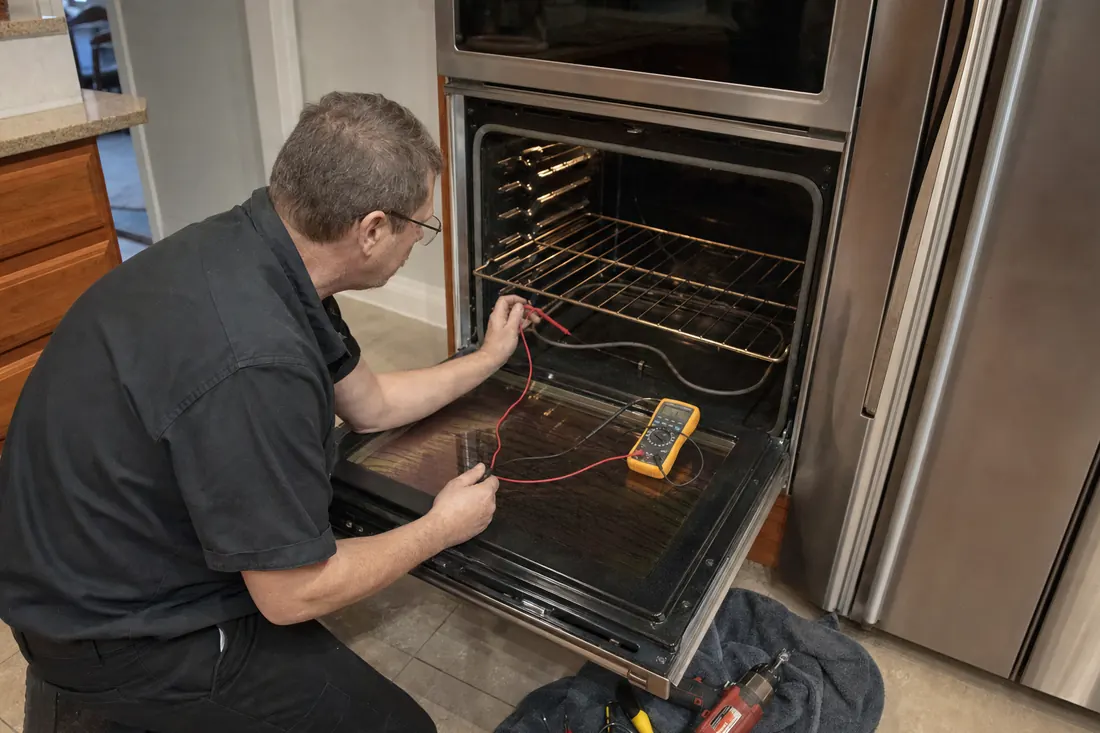
Technician testing the bake element of an open double wall oven with a multimeter, the open lower door visible in the picture - Steam Oven and Speed Oven Repair

Sound familiar?

What we get called out for

  • The steam oven asks to be descaled over and over
  • There is no steam at all, or only a little
  • Water sits in the bottom of the cavity after a cycle
  • The reservoir empties in minutes or never empties at all
  • The speed oven runs but the food comes out cold
  • It hums loudly then trips the breaker
  • The display lights up but nothing starts when the door closes
  • Water is leaking down the cabinet under the oven
  • The door seal is loose, torn or hanging out of its channel

What usually fails

These two appliances often live in the same cabinet stack and they fail for completely different reasons.

A combi-steam oven fails because of water. Every one of them either draws from a plumbed line or from a pull-out reservoir, heats that water in a generator or on an evaporator plate, and pushes the vapor into the cavity. Everything dissolved in the water stays behind. Scale forms first where the water is hottest, which is the generator element, and second where the water is stillest, which is the level sensor. A scaled level sensor is the classic hidden fault: the machine believes it has no water when it has plenty, or believes it is full when it is dry, and every downstream symptom looks like a pump problem.

The other steam-side failures are mechanical and predictable. Fill pumps and drain pumps work in a wet, mineral-heavy environment. Drain paths block. Reservoir seals harden and let the tank drain into the cabinet rather than into the machine, which is how water ends up running down the face of the cabinet below. Door seals on steam ovens take heat and moisture together and eventually go slack in the channel.

A speed oven fails electrically. It is a convection oven with a microwave generator bolted to it, and the microwave half is the half that breaks. The magnetron is the consumable. Around it sit a high-voltage transformer, a capacitor and a diode, and a failure in any of them presents identically to the customer: it runs, it sounds normal or louder than normal, and the food stays cold. A shorted diode in particular will take out a brand-new magnetron in minutes, which is why swapping the magnetron alone is a way of buying the same repair twice.

The other speed oven fault worth naming is the door. These use a sequenced interlock switch assembly. When the door sags or the latch wears, the switches operate out of sequence, the monitor switch does its job, and the line fuse blows. Customers describe that as the oven being completely dead. It is really a door adjustment plus a fuse plus a set of switches.

How we diagnose it

On the steam side we run the machine and watch the water: does the pump prime, does the generator reach temperature, does the drain clear, does the level sensor track reality. Then we look at the deposit. Soft, recent scale comes out with a service descale cycle. Hard, layered deposit means the generator and sensor come out for direct cleaning or replacement. We also check what the machine has been told about its water: that setting is programmed at installation, it is frequently left on the factory default, and it is what the descale interval is calculated from.

On the speed side the first action, every time, is to isolate and discharge the high-voltage capacitor. After that the line fuse, the interlock switches and the door alignment get checked in sequence, then the high-voltage components are tested individually. We never run a magnetron without a load.

What the repair involves

Both appliance types are usually built into a stacked column with a matching oven, so the trim comes off and the unit slides forward onto a support with the cabinet faces protected. Plumbed steam ovens get their supply shut and the line drained before anything moves.

Steam work finishes with a full descale of the generator, lines and sensor, new seals where they have hardened, and a complete steam cycle run to verify. Speed oven work finishes with a load test measuring actual heating performance, and any door, interlock or cavity repair is followed by a microwave leakage survey with a calibrated meter before we leave.

When it is worth repairing

Steam ovens are almost always worth repairing, because the failures are consumable — pumps, seals, elements, sensors — and because scale is maintenance rather than damage. A machine that has been descaled on schedule will outlast the kitchen.

Speed ovens deserve a straighter answer. The high-voltage components are reasonable parts and the repair is worth doing on a built-in unit, particularly when it shares a trim kit and a cut-out with the oven beside it. Replacement is not just the appliance, it is matching the column. Where we stop is a discontinued control board with no supply and no rebuild path. We tell you that at diagnosis rather than after ordering.

Independent service from Fruit Cove. Mon–Fri 8am–6pm, Sat 9am–4pm. Call +1 (904) 977-8701.
Brands

Steam & Speed Ovens we service

Try this first

Guides for this appliance

Some of it you can genuinely sort out yourself in ten minutes. We would rather you did than paid us to.

Steam & Speed Ovens: common questions

My steam oven keeps repeating its maintenance prompt. Why?

Because the descale reminder is usually a counter, and it only clears if the cycle is completed and confirmed the way the manufacturer specifies. The second cause is real scale that a consumer cycle cannot reach, on the level sensor or inside the generator. We run a service descale and, where the deposit has set hard, pull and clean the generator and the sensor directly.

Can I use household vinegar in it?

Please do not. Household vinegar is aggressive toward the aluminum, the pump seals and the gaskets in a steam oven, and the concentration is not controlled. Use the descaler the manufacturer specifies, which is normally a buffered citric acid product, and follow the interval the machine prompts for. That is the cheapest maintenance in the kitchen.

Is a speed oven repair safe to attempt myself?

No, and this is not a liability disclaimer. A speed oven contains a high-voltage capacitor that holds a lethal charge after the appliance is unplugged, and it has to be discharged deliberately before anything else is touched. It is one of the few appliance repairs where a mistake is fatal rather than expensive.

The speed oven runs but the food stays cold. What failed?

The microwave side is not producing output while the fan, light and turntable still work, so the fault sits in the high-voltage circuit — the magnetron, the diode, the capacitor or the transformer. We test the components individually rather than swapping the magnetron on principle, because a shorted diode will destroy a new magnetron within minutes.

Do you test for microwave leakage after a door repair?

Yes. Any work that touches the door, the interlocks or the cavity seal is followed by a leakage survey with a calibrated meter, checked against the federal performance standard. The result goes on the invoice. A shop that replaces an interlock switch and does not survey the door afterward is skipping the step that matters.

What do you check first when a steam oven will not fill?

The reservoir seating or, on a plumbed unit, the supply and the inlet valve, then whether the pump primes at all, then the level sensor. A level sensor reading wrong is the classic hidden fault, because the control acts faithfully on a number that is not true and every downstream symptom then looks like a pump failure. Checking those in order costs nothing and rules out most of the expensive answers.

Customer feedback

After a steam & speed ovens visit

Rated 4.8 out of 5 across 72 customer reviews. These three describe this job in particular.

Ronan E.May 31, 2026

The combination oven tripped the breaker every time it switched into steam. A leaking boiler seal was wetting the element terminals. He replaced the seal and the element, dried out the cavity and retested it three times.

Willa G.Jul 3, 2026

Our speed oven was cooking one side faster than the other. He found the turntable coupler stripped and the convection blade cracked. Both were changed and he ran a test bake before leaving. The results are even now.

Fenella D.Dec 18, 2025

The speed oven heated but the microwave side did nothing. He tested the magnetron and the high voltage diode, found the diode had failed short and replaced it. He cleaned the waveguide cover while it was open.

Read all 72 reviews

Talk to a technician

Steam & Speed Ovens giving you trouble?

Read us the model and serial number off the data plate along with what it is doing. That is usually enough for us to tell you what we expect to find.

+1 (904) 977-8701 Book online
  • $129 flat diagnostic , credited toward the repair
  • 2-hour arrival windows, with a call ahead
  • Mon–Fri 8am–6pm · Sat 9am–4pm
Call now +1 (904) 977-8701 Rather not call? Book online