What usually fails
Every full-size Sub-Zero built-in uses dual refrigeration: two completely separate sealed systems, two compressors, two evaporators. The fresh-food side is held cool and moist at a factory setpoint of 38°F. The freezer is held frigid and dry at 0°F, which is why food does not freezer-burn in one of these the way it does in a side-by-side from a big-box store. Understanding that architecture is the whole job. One system can die while the other runs perfectly, so “warm fridge, fine freezer” is the expected presentation, not a puzzle. Any technician talking about the compressor on a built-in has not opened one.
Airflow is the number one real-world root cause. Sub-Zero asks for a condenser cleaning every six to twelve months, sooner in a house with pets. Where the condenser lives depends on the platform: Classic and Legacy Classic cabinets (the BI series, produced from roughly 2008 to 2022) carry the compressor and condenser at the top behind a flip-up grille. Designer and Legacy Integrated columns (IT, IC, ID, and the current DEC and DET) carry them at the bottom. The 700 Series is bottom-mounted too, and if custom cabinetry has boxed in the kickplate, Sub-Zero warns that can cause problems up to and including sealed system failure.
After airflow, the recurring failures are evaporator fan motors, defrost heaters and terminators, thermistors, door gaskets, water valves, and control boards. Below all of that sits the sealed system itself — compressor, condenser, evaporator, drier, connecting tubing — which is the work most shops will not touch.
How we diagnose it
We start at the serial tag, because on these units the correct part is serial-number dependent. Control boards in particular supersede repeatedly, and fitting the wrong revision to a 700 Series cabinet is a wasted trip. On Designer Tall, Designer Drawer and 700 Series units the tag sits inside the cabinet to the left of the upper drawer.
Then we read the panel. EC50 with SERVICE flashing, EC40 for excessive freezer compressor run, an EE code on a 600 Series, a wrench icon and alarm chime on a Legacy Classic — each of those points somewhere different. We log the code before anything gets cleared.
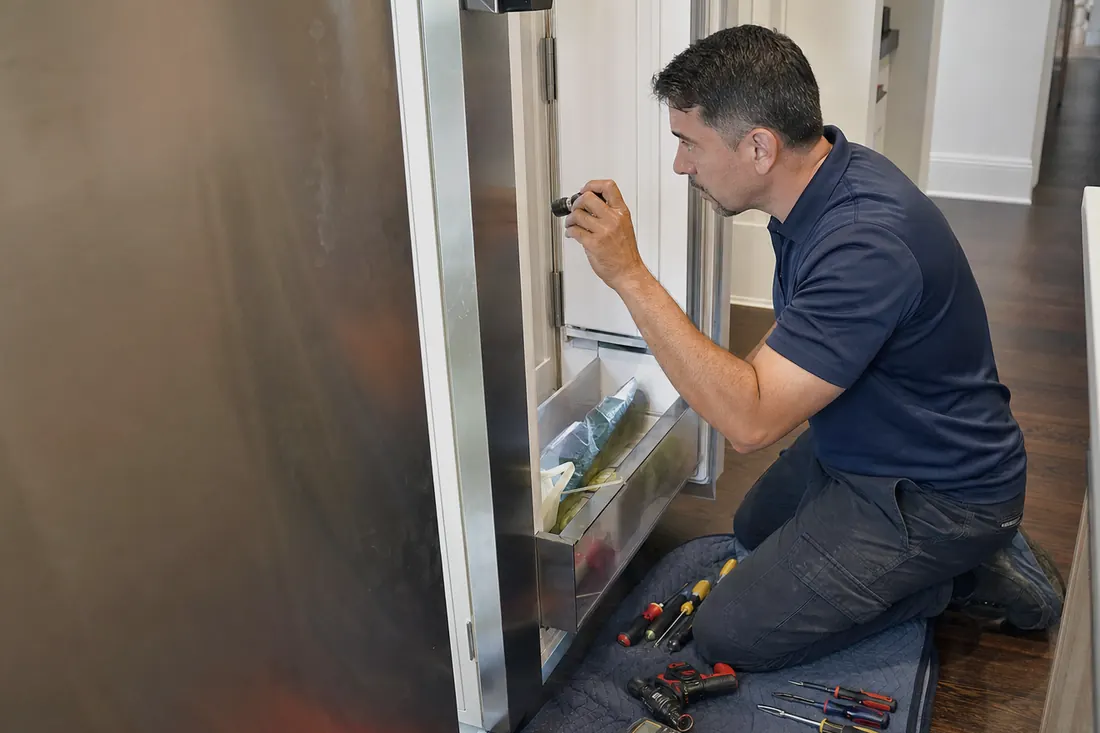
Next, actual temperatures against actual setpoints, taken with our own instruments rather than the display. The gap between the two matters: Sub-Zero’s own triage rule on EC40 is that under 10 degrees above setpoint points at the condenser, and more than 10 degrees above setpoint with no door left open points at a component or sealed system fault. From there we test the suspect side on its own — fan draw, defrost circuit continuity, thermistor resistance, compressor start and run behavior, and where warranted, sealed system pressures.
What the repair involves
Most jobs finish on the first visit because we carry what actually fails: evaporator and condenser fan motors, drain heaters, thermistors, door switches, water valves, common gaskets and filters. We install genuine OEM parts. Aftermarket boards and generic gaskets do not hold on these platforms — gaskets are cut per platform, and the wrong drier or evaporator compromises the whole sealed system.
Pulling a Designer or Integrated column out for bottom-mounted compressor access is a genuine cabinetry risk in a custom kitchen. We protect floors and adjacent cabinet faces before the unit moves, and we move it deliberately. Sealed system work is done in your home under EPA Section 608, with refrigerant recovered rather than vented.
When it is worth repairing
Almost always, and the reason is structural. A built-in is not a freestanding appliance — it is joinery. The cabinet is trimmed into the millwork, the door carries a custom panel and hardware matched to the rest of the kitchen, and the opening was framed around that exact model. Replacing it is a cabinetry project with an appliance attached.
The mechanical parts, meanwhile, are the cheap half of the machine and they are still available: Sub-Zero guarantees parts for at least 15 years on most models and far longer on many. A compressor swap on a 2011 BI-42UFD leaves you with a refrigerator that has another decade in it.
One honest exception. If a unit has had multiple unrelated sealed system failures, has visible cabinet corrosion from years of a leaking drain, or is a legacy 500 or 600 Series with a failed system and a rusted-out interior, we will tell you it is time. We would rather lose the job than sell you a repair we do not believe in.
Worth knowing if your unit is in its sixth through twelfth year: Sub-Zero’s limited twelve-year sealed system warranty covers those parts, and their own warranty document states that an owner using non-certified service still obtains the covered part directly from Sub-Zero. You pay labor and other costs; the part itself may still be covered. We will point you to that before we quote you.