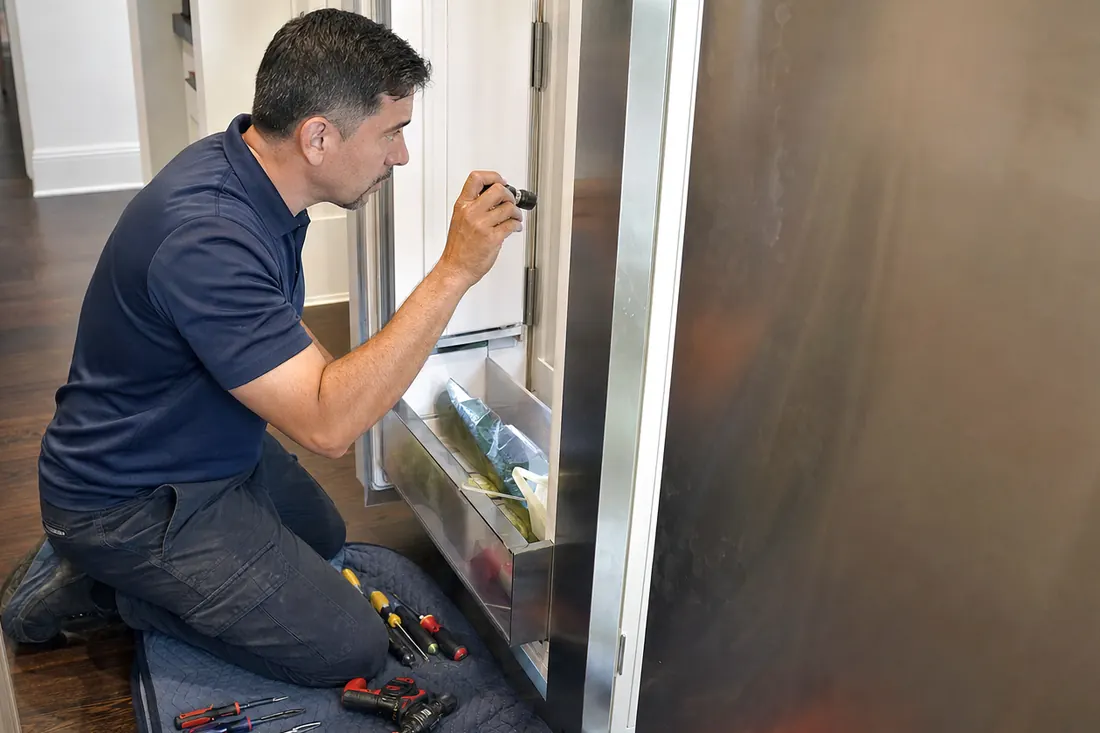
What usually fails
An ice maker is a chain. Water leaves the house supply, passes a shut-off valve, passes a filter (sometimes two, if there is a whole-house unit nobody remembers), reaches an electric inlet valve, travels a fill tube, drops into a mold, freezes, gets ejected, and lands in a bin with its own level sensing. A break anywhere reads to the owner as “the ice maker is broken.” It usually is not.
The failures we actually find:
Water supply and filtration. Low pressure is the most under-diagnosed cause, and it announces itself with small or hollow cubes rather than with no ice at all. Right behind it is a filter that has done its job for two years and is now a restriction. Sub-Zero publishes filter part numbers by platform: 4204490 and 9030868 are twist-in filters covering Classic, Designer and PRO refrigeration, 7045454 is the current Classic push-in filter, and 7042803 is the NSF certified filter for the UC-15I undercounter ice maker.
A frozen fill tube. Water dribbles instead of filling, the tube ices closed from the tip back, and production stops entirely. This is common and it is fixable.
Temperature. The ice maker will not run if the freezer is not cold enough. Sub-Zero’s threshold is at or below 5°F, and they recommend 0°F. A freezer sitting at 12°F because its condenser is packed with dust will make no ice at all, and swapping the ice maker will change nothing.
The mechanical bits. A shut-off arm left in the up position, a missing white plastic rudder arm, a bin that is not seated level, or a jam from cubes that fused during a slow cycle. These are cheap failures with a large nuisance value.
The sealed system, on standalone undercounter machines. A UC-15I is a self-contained refrigeration unit rated to produce up to 50 pounds of ice a day and store 25 pounds, drawing 115 VAC on a dedicated 15 amp circuit. When its compressor or evaporator fails, it needs a refrigeration technician, not an appliance parts swap.
How we diagnose it
We work the chain in order rather than starting at the ice maker, because starting at the ice maker is how people end up paying for a module that was never the problem.
Water pressure and flow at the unit come first, measured, not guessed. Then the filter, its age and its seating. Then the inlet valve — coil resistance and actual fill volume on a timed cycle. Then the fill tube for ice. Then freezer temperature taken with our own probe rather than off the display, and if it is high we go look at the condenser before anything else.
Only after all of that do we test the ice maker itself: module, mold heater, thermostat or thermistor, ejector, shut-off arm and bin sensing. On a standalone undercounter machine we add condenser condition, fan draw, drain routing and pump function, and where warranted, sealed system pressures.
What the repair involves
Most ice maker jobs finish on the first visit. Inlet valves, fill tube heaters, filters, rudder arms and shut-off arms are small parts and we carry the common ones. A frozen fill tube is cleared with controlled warmth, never with a screwdriver or boiling water — puncturing a fill tube or a drain heater turns a one-hour visit into a much larger repair.
Undercounter machines usually have to come out of the cutout, which exposes the surrounding cabinetry, the toe kick and the floor. In a Fruit Cove bar area that stone or wood floor is worth more than the machine, so it gets protected before anything moves. Plumbed units get their supply and drain reconnected and pressure-checked, and we run a full harvest cycle so you see ice before we leave.
Sealed system repairs on undercounter ice machines are performed in your home by EPA Section 608 certified technicians. The EPA classifies under-the-counter ice makers as small appliances, so that certification is a federal requirement, not a marketing line.
When it is worth repairing
For an ice maker built into a Sub-Zero refrigerator, the answer is nearly always yes. The parts are inexpensive relative to the cabinet they live in, and none of the failure implicates the refrigerator itself.
For a standalone undercounter machine, the deciding factor is whether the sealed system is intact. Valves, pumps, fans, boards and thermostats are all straightforward repairs on a unit that is otherwise sound, and a well-kept undercounter machine runs for well over a decade. A compressor failure on a fifteen-year-old machine is a closer call, and we will give you the honest arithmetic rather than the arithmetic that favors us.
One thing worth doing either way: if the unit is plumbed and drains to a pump, check the drain routing annually. Most of the water damage we get called to in bar and pantry installations traces back to a drain, not to a refrigeration fault.