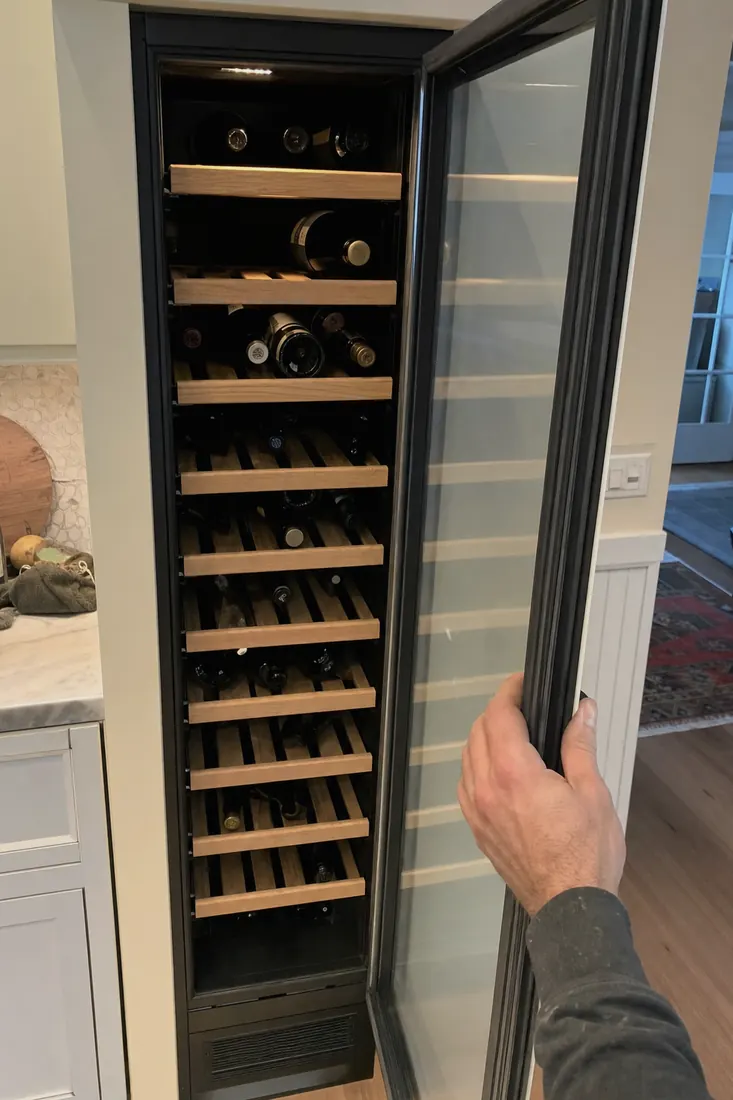
What usually fails
A wine cabinet has a harder job than a refrigerator. It has to hold a narrow band of temperature, hold it steady, keep humidity high enough that corks do not dry, and do it without transmitting vibration into the bottles. When any one of those slips, the wine suffers long before the owner notices, which is why a two-degree drift matters more here than a two-degree drift in a fresh-food compartment.
The failures we find, roughly in order of frequency:
Restricted condensers. Undercounter wine units live in a sealed cabinet cutout with a toe-kick grille as their only air path. Once that grille is packed with dust, the condenser cannot reject heat, the compressor runs continuously, and the cabinet still drifts warm. The Sub-Zero 424 shares the UC undercounter platform and cleans from the front; the discontinued full-size 430 is unusual in carrying its compressor and condenser at the top of the unit, while the 427 and 427RG share the 700 Series platform and clean from the bottom. Getting this wrong wastes an hour and leaves the coil dirty.
Zone control components. In dual-zone cabinets the two zones are rarely two refrigeration systems. They are one system, split by a damper, a distribution fan and separate sensors. A failed thermistor reads a temperature that is not there and the board obediently holds the wrong setpoint. A stuck damper starves one zone entirely. Both present as “one side works, one side does not,” and neither requires touching the sealed system.
Door seals and closure. Glass doors on wine cabinets are heavy, and hinges take a lot of cycles in a house that entertains. A gasket that has compressed flat, a door that hangs a few millimeters low, or a cabinet that has settled will all leave a thin air path. That shows up as condensation on the glass, a compressor that never shuts off, and frost on the coldest zone.
Sealed system faults. Less common than the above, but real: a compressor that starts and immediately trips its overload, a partial restriction at the drier, an evaporator leak. This is where most repair companies stop and recommend replacement.
How we diagnose it
We log the model and serial first — on Sub-Zero wine storage the suffix tells us the configuration before we open anything. W is wine storage, G is a glass door, /O is a panel-ready overlay, and a DEU prefix tells us it is a Designer undercounter cabinet with a bottom-mounted system.
Then we take real temperatures in both zones with our own probe, placed where a bottle actually sits rather than in the airstream, and we watch a full cycle. A cabinet that reads 55 on the display and 63 at the bottom shelf is telling you a great deal. We check the condenser condition, measure fan draw, test each zone sensor against its resistance curve, verify damper travel, and check door closure with a light and a slip of paper around the full gasket perimeter.
Only when the control side is cleared do we put gauges on anything.
What the repair involves
Sensors, fan motors, dampers and gaskets are same-visit repairs and we carry the common ones. Gaskets are platform-specific — a Designer wine door and a Classic wine door take different profiles, and Sub-Zero recommends a technician do gasket replacement rather than the owner, because the seat has to be set correctly or the new gasket seals worse than the old one.
Control boards get verified against the serial tag before they are ordered. On these platforms, boards supersede often enough that a part number alone is not a fit.
Sealed system work is done in your home by EPA Section 608 certified technicians, with refrigerant recovered rather than vented. Undercounter cabinets usually have to be drawn out of their cutout for that work, and in a bar or butler’s pantry the surrounding cabinetry is often the most expensive thing in the room. We protect it before the unit moves.
When it is worth repairing
Start with what is in the cabinet. A 46-bottle undercounter unit holding an ordinary collection is one calculation; a full-size column holding two hundred bottles that have rested for a decade is another entirely. In the second case the repair is insurance on an asset worth far more than the appliance.
Built-in wine storage is also joinery. A full-size wine column has an 80 to 84 inch finished height, an overlay panel matched to the kitchen, and an opening framed to that exact model. Replacing it is a millwork job.
Where we will tell you to stop: a compact thermoelectric wine unit with a dead cooling module, or a cabinet whose interior has corroded from years of a leaking seal. Those are honest replacements, and we say so on the first visit rather than after you have paid for parts.