What usually fails
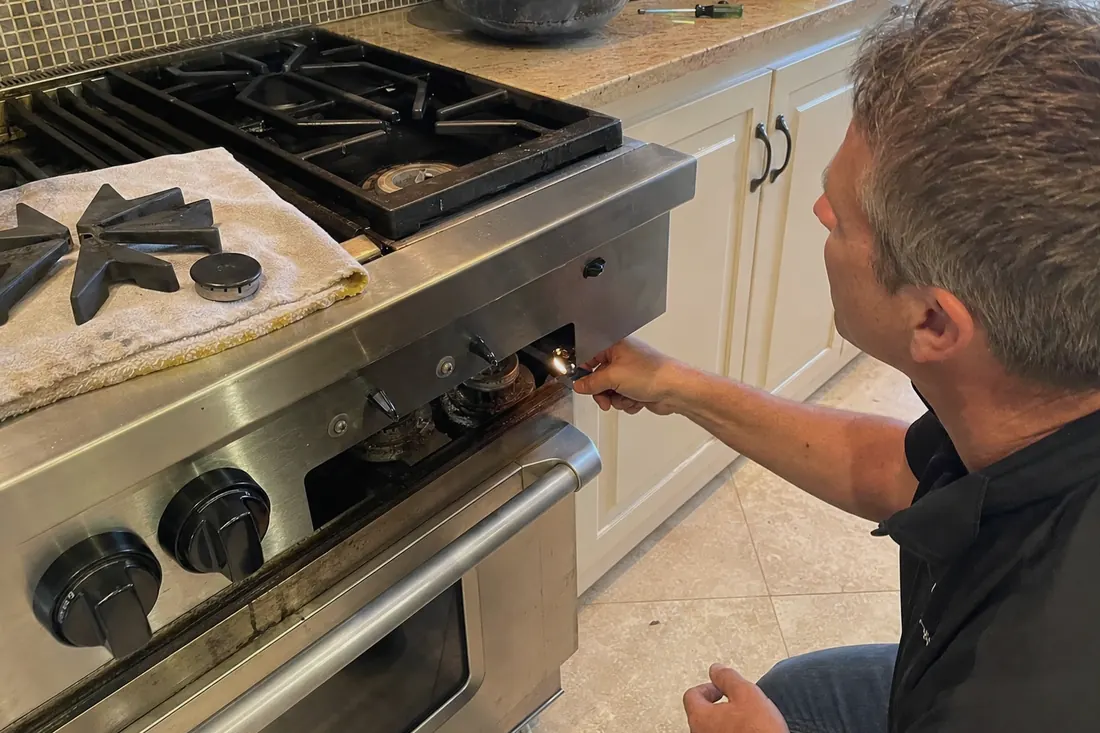
On a professional gas range the failure is almost always at the burner, not in the electronics. Sealed burners on Wolf, Viking and Thermador rangetops use a spark electrode mounted in a ceramic insulator alongside the burner head. That ceramic cracks from thermal cycling and from being knocked with a pan. Once it cracks, the spark takes the short path to ground instead of jumping the gap to the burner, and you get clicking with no ignition. The other high-frequency item is the burner cap. Set down a millimeter off center and the flame goes uneven, lazy and yellow — which people read as a gas supply problem when it is a two-second seating issue.
Gas valves are next. The stem grease in a professional valve is a heavy silicone compound. After a decade of heat cycles it stiffens, the knob gets gritty, and the simmer detent stops holding a low flame. Griddles and infrared charbroilers fail differently: the ceramic burner face degrades and the flame pattern goes patchy, or the separate control thermostat loses its charge.
Induction is a different animal. The coils themselves almost never fail. What fails is the inverter board, the cooling fan that keeps it alive, and the supply. These cooktops run on a 240-volt circuit with two hot legs, and losing one leg at the breaker or at a loose lug kills half the cooking surface while the other half works normally. That symptom sends a lot of people shopping for a new cooktop when the fault is in the panel.
On dual-fuel ranges the top and the oven are effectively two appliances. A gas top with an electric oven means burner faults and oven faults have nothing to do with each other, and they get diagnosed separately.
Rangetop, range or cooktop
The three words get used interchangeably and they are three different appliances, which matters because the parts are not shared.
A range carries its own oven underneath. A rangetop is the professional burner deck with nothing but cabinetry or a wall oven below it, which is why it turns up in almost every remodelled Jacksonville kitchen that put a pair of wall ovens in a tall cabinet. A cooktop is the lighter drop-in unit, gas, electric or induction, with a shallow chassis and no oven relationship at all.
We repair all three. The one thing we need before ordering anything is the model number from the data plate, because a burner assembly for a 36-inch rangetop and the visually identical part on the range version of the same series are frequently different castings.
How we diagnose it
We start at the data plate, not the internet. On Sub-Zero Group products the model on the tag often carries an ICB prefix ahead of the number you know the unit by, and that full string is what determines the correct part.
Gas work begins with a manometer on the manifold. Without a measured pressure, every downstream conclusion is a guess. We confirm the appliance is set for the fuel it is actually connected to, check orifice sizing, and read the pressure with burners lit rather than static. Electrodes get ohmed and inspected under light for hairline cracks. Spark modules get checked for a solid chassis ground, which is the cause of more phantom clicking than any bad module.
For induction and for electric elements we take voltage at the terminal block on both legs under load, then work inward to the inverter and the fan.
What the repair involves
A 48-inch professional range weighs several hundred pounds and sits on a stone or wide-plank floor. Before anything moves, the gas is shut at the appliance valve, the floor is covered, and the range comes forward onto hardboard so the feet never touch the finish. Rangetops and drop-in cooktops come up from above, which is easier, but the counter edge gets protected the same way.
Everything that opens a gas joint gets leak-tested with solution on reassembly. The range is re-leveled front to back so pans sit flat, and the anti-tip bracket goes back where it belongs. We install genuine OEM parts. Burner caps and heads are model-specific, and port geometry that looks close enough will give you a flame that is not.
When it is worth repairing
Almost always, on this class of equipment. Electrodes, caps, valves and igniters are modest parts on a range that was a serious purchase and is built to be rebuilt. The honest exception is a discontinued control board with no supply left. When we hit that, we say so on the first visit rather than ordering parts to find out.
Replacement is rarely just the appliance. A 48-inch range or a flush-set cooktop sits in a cut-out that was built around it, next to a hood sized for it. We would rather fix the burner.
We are an independent shop, based in Fruit Cove and working Mon–Fri 8am–6pm and Sat 9am–4pm. Call +1 (904) 977-8701.