WALL · ISLAND · REMOTE BLOWER

Range Hood and Ventilation Repair

Blower motors, speed controls, lighting and remote blower wiring on professional wall, island and under-cabinet ventilation.

40-mile radius$129 diagnostic90-day labor warranty

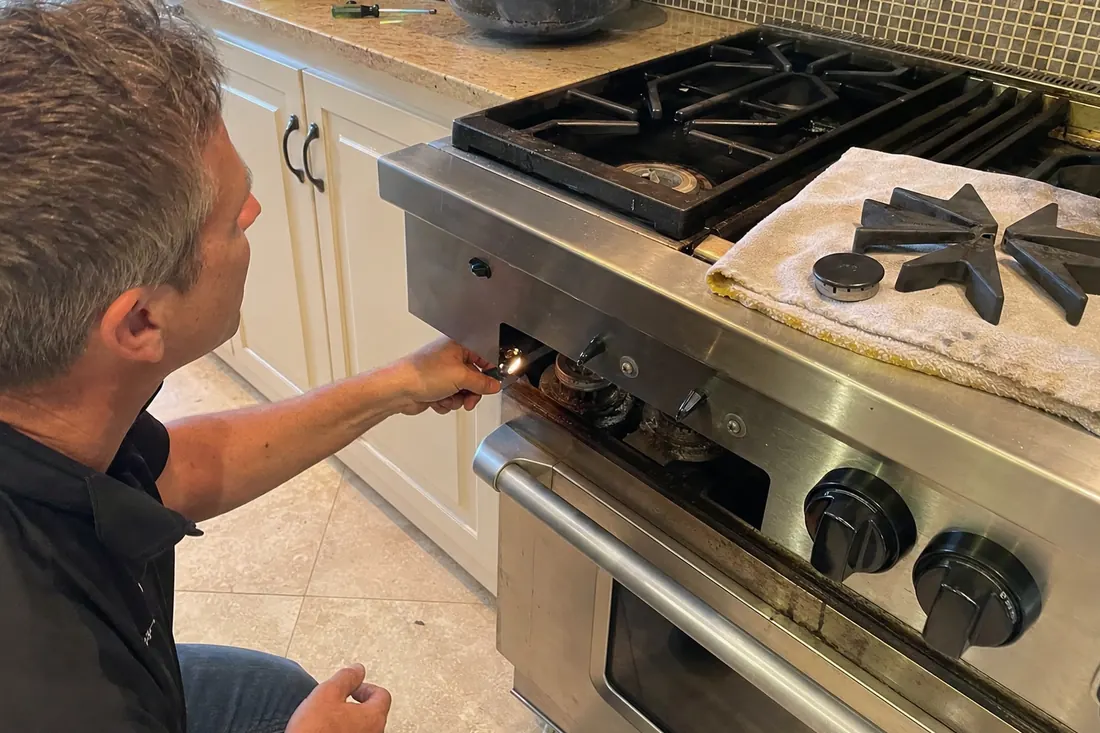
Technician checking the igniter on a dual-fuel range, one burner cap lifted off, the lifted grate visible in the picture - Range Hood and Ventilation Repair

Sound familiar?

What we get called out for

  • The hood runs but barely pulls any air
  • Loud rattle or howl at high speed
  • Only one fan speed works
  • Lights are out or flickering
  • The touch controls do nothing
  • It turns itself on, or will not turn off
  • Grease dripping back down onto the cooktop
  • Cold air blowing back down the duct

Ventilation is the part of a professional kitchen that gets ignored until it stops working, and then it becomes obvious very quickly. A 60,000 BTU rangetop under a hood that has lost half its airflow puts grease on the cabinets, moisture in the drywall and smoke in the rest of the house.

What usually fails

Blower motors fail on bearings, not on windings. The first sign is noise — a rumble or a howl that appears at high speed and later at every speed — followed by a motor that runs hot and eventually stalls. A squirrel-cage wheel that has been running out of balance because of caked grease will destroy the bearings long before the motor itself is worn out, so we always inspect the wheel, not just the motor.

Speed controls are next. On a variable-speed hood the control board delivers a different voltage or a different signal to the blower at each setting. When a stage fails you get a hood that works on high and nothing else, or one that only runs at full tilt. That is a board or a switch, not a motor.

Lighting is its own category. Halogen sockets discolor and lose contact from years of heat, and LED assemblies fail at the driver more often than at the diodes. Flickering across all lamps points at the driver or the transformer; one dark lamp points at the socket.

Then the parts that are not electrical at all. Backdraft dampers rust or jam, so the hood pulls against a closed flap. Duct runs get crushed during other trades’ work. Baffle filters seat incorrectly after cleaning and let grease bypass straight into the blower housing. And a hood that was ducted with too many elbows or too small a diameter never performed correctly from the day it was installed — no repair fixes that, and we will say so.

How we diagnose it

We establish the configuration first, because it determines everything else. Internal blower, inline blower in the duct run, or remote blower on the roof or exterior wall. A hood with a remote blower has power and a low-voltage control signal leaving the canopy and going somewhere else in the building, and half the faults we find on remote systems are in that run rather than in either end.

From there it is straightforward electrical work. We confirm supply voltage, then check what the control is actually sending at each speed setting, then check what the blower is receiving. If the blower gets the correct signal and does not respond, the motor or its capacitor is the fault. If it never receives the signal, the control or the wiring is.

Airflow gets checked at the hood face rather than assumed. A hood that measures well but does not capture is a duct, damper or filter problem. A hood that measures poorly with clean filters and an open damper is a blower problem.

What the repair involves

Canopy work is done on site with the cooktop and countertop covered. Blower assemblies on wall and island hoods usually drop out from below once the filters and the internal baffle plate are removed. Island hoods sometimes require lowering the canopy on its support rods, which is a two-person job and one we schedule as such rather than improvising.

Inline blowers in an attic are reached through the existing access. Remote blowers on the roof are assessed for safe access before we quote. Coastal salt air is hard on exterior blower housings, and a corroded housing sometimes has to be replaced along with the motor.

Control panels, lamps, sockets and dampers are usually a single visit. Motors and boards are ordered against the model and serial plate, which on most hoods is inside the canopy behind the filters.

When it is worth repairing

Nearly always. A professional hood is a steel canopy, a motor, a control and some lighting, and every one of those is a serviceable part. The canopy itself — the expensive, custom-sized, custom-finished piece — is what you are actually protecting, and it very rarely fails.

The exception is a hood whose original duct design was wrong. If the run is undersized, over-elbowed or terminating badly, replacing the motor buys you nothing. We would rather tell you that on the first visit than sell you a blower.

Appliance Repair Jax is an independent company based in Fruit Cove, serving Jacksonville and St. Johns County within a 40-mile drive. Monday to Friday 8am to 6pm, Saturday 9am to 4pm.
Brands

Range Hoods we service

Try this first

Guides for this appliance

Some of it you can genuinely sort out yourself in ten minutes. We would rather you did than paid us to.

Range Hoods: common questions

My hood is running but the kitchen still fills with smoke. Is the motor bad?

Not necessarily. Loss of airflow is more often a loaded baffle filter, a stuck backdraft damper or a crushed section of duct than a failed motor. We measure airflow at the hood and check the whole path before touching the blower. A motor that is genuinely failing usually announces itself with noise or a speed that no longer changes.

Where is the blower on my hood? A technician told me there isn't one.

Many professional hoods use a remote or inline blower rather than a motor inside the canopy. Inline blowers sit in the duct run, often in the attic, and remote blowers mount on the roof or an exterior wall. The hood itself may contain only lights, filters and the control, which is why an unfamiliar technician cannot find the motor.

Why did my hood start turning on by itself?

That is usually a control fault or moisture in the touch panel, not a ghost in the wiring. Heat and steam rising past a poorly sealed control membrane will make a capacitive panel read phantom presses. We test the panel and the control board separately so you are not paying to replace both.

Do you service roof-mounted blowers?

Yes, when the unit can be reached safely from a ladder or an accessible roof. Exterior blower housings in a coastal climate take a beating from salt air and moisture, and corroded housings, seized bearings and degraded wiring are common. We assess access first and tell you honestly if the job needs a roofer alongside us.

How often should the filters be cleaned?

For a household that cooks most nights, roughly every month for stainless baffle filters. Grease-loaded filters are the single biggest cause of poor capture, and a saturated filter puts extra load on the blower motor. Baffles go in the dishwasher; mesh filters usually do not survive it.

Are you an authorized service center for these brands?

No. We are an independent appliance repair company and we are not affiliated with, authorized by or endorsed by any of the manufacturers we service. We repair their ventilation equipment and install genuine OEM parts. Brand names are used here only to describe the appliances we work on.

Customer feedback

After a range hoods visit

Rated 4.8 out of 5 across 72 customer reviews. These three describe this job in particular.

Ignatius R.Apr 30, 2026

The hood had gone from a whisper to a roar while pulling almost nothing. Both blower bearings were shot and the duct damper was stuck shut. He replaced the blower assembly and freed the damper. It is quiet and it works.

Susannah W.Jan 4, 2026

The downdraft would rise but not retract. He cleaned and lubricated the lift track and replaced a worn drive belt, then had to come back once the second belt arrived because the first was not the right profile.

Caspian B.Jun 26, 2026

Our hood rattled loudly whenever it ran above half speed. A mounting bracket had worked loose and one baffle was warped. He shimmed the bracket, replaced the baffle and rebalanced the blower wheel. The rattle is gone.

Read all 72 reviews

Talk to a technician

Range Hoods giving you trouble?

Read us the model and serial number off the data plate along with what it is doing. That is usually enough for us to tell you what we expect to find.

+1 (904) 977-8701 Book online
  • $129 flat diagnostic , credited toward the repair
  • 2-hour arrival windows, with a call ahead
  • Mon–Fri 8am–6pm · Sat 9am–4pm
Call now +1 (904) 977-8701 Rather not call? Book online