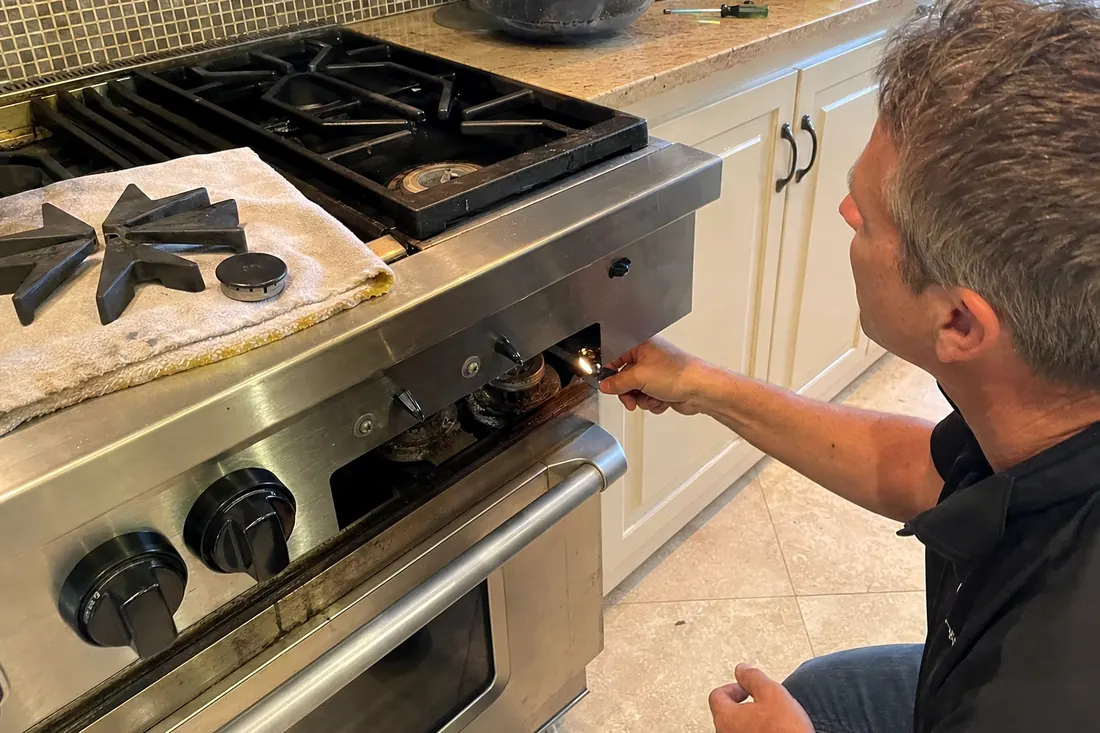
An outdoor kitchen asks appliances to do the same job they do indoors, in a place that is 95 degrees, 85 percent humidity and eight miles from salt water. Almost every fault we find out there traces back to one of three things: heat the unit cannot shed, water that cannot get away, or an indoor-rated appliance installed where it never should have gone.
What usually fails
Start with the installation, because it causes more failures than any component. Sub-Zero’s model key marks outdoor undercounter units with the suffix O — the UC-24RO is the 24-inch outdoor refrigerator — and only those units are built for the conditions. An indoor UC-24R dropped into a stone island will run for a season or two and then start showing corroded hinges, a swollen gasket, condensation inside the cabinet and eventually electrical faults.
Second is condenser airflow. Undercounter refrigeration rejects heat through a condenser coil that needs air in and air out, and a masonry island built as a sealed box recirculates the unit’s own exhaust. The compressor runs continuously, head pressure climbs, and box temperature drifts up in the afternoon and recovers overnight. Owners describe this as “it only struggles when it’s hot,” which is exactly what a starved condenser does. Sub-Zero’s own guidance is to clean the condenser every six to twelve months; an outdoor unit collecting pollen, dust and grass clippings needs it more often.
Third is water. Undercounter ice makers either gravity drain or use a drain pump — Sub-Zero’s UC-15I has no pump, while the UC-15IP does — and outdoor installations often have a marginal drain run to begin with. A blocked drain backs up under the bin, freezes into a block, and looks for all the world like a production failure. On the supply side, low water pressure is the specific cause of small or hollow cubes, and an expired inline filter is a common culprit.
Then the genuinely worn parts: condenser and evaporator fan motors, door gaskets that harden and split under UV, hinges and fasteners that corrode, thermistors that drift, and control boards that fail after years of humidity cycling.
How we diagnose it
We photograph the serial tag first, because parts on undercounter refrigeration are model and revision specific and outdoor variants are not interchangeable with their indoor counterparts.
Then we measure. Box temperature against setpoint, condenser inlet and outlet air temperature, and compressor current draw. Those three numbers separate an airflow problem from a sealed system problem quickly. A unit with a clean condenser, correct airflow and a compressor drawing correctly that still will not hold temperature has a refrigerant or a component fault, and that is where EPA Section 608 certified work begins.
We also check the island itself. If the ventilation cutouts are undersized, blocked by pavers, or simply not there, no part we fit will keep the unit alive. That gets written into the report along with the repair.
For ice makers we work Sub-Zero’s own order of checks: allow a full 24 hours after any temperature change, confirm the unit is switched on, verify the water supply valve and pressure, check the filter, check the fill tube for a freeze-up, and confirm the bin is seated and the shut-off arm is down.
What the repair involves
Undercounter units come out of the island for most component work. That is done carefully — outdoor islands are stone or stucco with tight tolerances and no forgiveness, and we protect the face and the countertop edge before anything moves. Where a unit was set into a masonry surround with no service clearance, we will tell you what has to come apart before we start, not halfway through.
Fan motors, gaskets, thermistors, ice maker modules, valves and drain pumps are usually one visit. Sealed system work — compressor, evaporator, drier, tubing — is done on site with proper recovery, evacuation and charging, and is quoted separately after the diagnosis.
When it is worth repairing
Outdoor refrigeration is expensive to replace and, in a finished island, expensive to replace properly, because the surround usually has to be opened up. A unit with a sound cabinet and a repairable fault is nearly always worth fixing.
The honest exception is an indoor-rated unit that has been living outdoors for years. Once corrosion has reached the cabinet, the door frame and the wiring, you are patching a machine that is failing in several places at once. In that case we will tell you to replace it with a properly outdoor-rated model, and we will tell you what the island needs for ventilation so the next one lasts.
Appliance Repair Jax is an independent company based at 164 Johns Glen Dr, Jacksonville, FL 32259, serving homes within a 40-mile drive. Monday to Friday 8am to 6pm, Saturday 9am to 4pm. Call +1 (904) 977-8701.