Buying & owning
Repair or Replace a Built-In Appliance: The Cabinetry Math
The 50 percent rule was written for freestanding appliances. Built-ins are cabinetry, and that moves every threshold. Honest numbers by appliance type.
Anyone can do this
No tools, no disassembly, and nothing that can void a warranty.
Covers these symptoms
- is it worth repairing
- should I replace my built-in oven
- the repair costs almost as much as a new one
- how long should a built-in appliance last
- the part is discontinued
What you need
- Model and serial numbers from every appliance in question
- A tape measure
- Kitchen cabinet elevation drawings, if you have them
- A written repair estimate
- A written replacement quote that includes installation
The advice everyone has heard is the fifty percent rule: if the repair costs more than half the price of a new one, replace it. That rule is sound, and it was written for appliances you can carry through a door.
A built-in is not one of those. It is a component of your kitchen’s cabinetry, and once you count what has to happen to the cabinetry, every threshold moves.
The number people leave out
When a freestanding appliance is replaced, the cost is the appliance, delivery and an hour of someone’s time. When a built-in is replaced, the cost is the appliance plus everything the opening forces:
- Custom panels and trim kits. Panel-ready refrigeration, dishwashers and undercounter units take door panels made by a cabinetmaker to match your kitchen. Those panels were built for that door, on that hinge, with that reveal. New appliance, new panels, and the cabinetmaker has to match a finish that has aged fifteen years in your kitchen.
- Opening dimensions that changed between generations. Manufacturers revise heights, depths, toe kicks and grille details between platform generations, so a swap that looks like a drop-in on a spec sheet routinely needs filler strips, a modified surround or a rebuilt cabinet face.
- Discontinued sizes. The sharpest edge. Twenty-seven inch wall oven openings, unusual undercounter widths and older double-oven cutouts often have no modern equivalent, and when the size is gone, replacement means rebuilding cabinetry rather than buying an appliance.
- The delivery path. Large built-in refrigeration can exceed 700 pounds. In the 1900s to 1930s kitchens of Riverside, Avondale, Old Ortega, San Marco and Old Mandarin, the doorway, the stair turn and sometimes the floor structure are the real constraint — a carpentry job attached to an appliance purchase.
- Services that no longer match. Newer specifications may want a dedicated 20-amp circuit a 1920s house does not have, a different gas orifice or regulator, a different duct diameter for a hood, or a condensate route the dishwasher install never had.
So the honest comparison is never “repair estimate versus sticker price.” It is repair estimate versus the fully loaded installed replacement cost — appliance, delivery, install, disposal, panels, trim, cabinetry, electrical, gas, venting and plumbing.
Get that number in writing from a dealer before you decide anything. It is very often two to four times the sticker price on refrigeration and wall ovens, and that difference is precisely why built-ins are worth repairing long past the point where a mass-market appliance is not.
The threshold, honestly stated
Repair when the written estimate is below roughly 40 to 50 percent of the fully loaded replacement cost, and the appliance has meaningful life left.
Two adjustments to that:
- Move the fraction up when the appliance is otherwise sound, parts are current, and the failure is a single well-understood component. Replacing one system in an appliance whose replacement is a five-figure project is good economics even at a high absolute number.
- Move the fraction down when you have already spent money on it twice in two years, when several unrelated systems are degrading at once, or when the fault list includes anything structural.
Thresholds by appliance type
Built-in and integrated refrigeration
The most repair-favorable category on this list, because the replacement cost is the highest and the failures are usually modular — fans, boards, heaters, gaskets, valves, thermistors, and sealed system components that a technician with EPA Section 608 certification can address in the home.
Replace when: the cabinet or interior liner is physically damaged; there is corrosion through the case, which we do see on coastal and garage installations; or the evaporator has failed inside foamed-in-place insulation such that access means destroying the cabinet.
Wall ovens
Doors, glass panels, hinges, thermostats, sensors, elements, fans and door latches are all normal repairs, and a wall oven cavity is a simple, durable thing.
Replace when: the inner cavity liner is cracked or burned through; the wiring harness inside the cavity has heat-damaged insulation along its length; or the control board is genuinely obsolete with no supersession. Watch the opening size before committing — discontinued cutout widths are the most common unpleasant surprise in this category.
Dishwashers
Closer to conventional math than the rest, because a good built-in dishwasher’s fully loaded replacement is high but not extreme. Pumps, motors, valves, boards, racks, seals and control panels are routine.
Replace when: the stainless tub itself is leaking at a seam, or the sump chassis is corroded. A tub failure is the end of a dishwasher regardless of brand. Also weigh the panel: if yours is panel-ready with a custom front, that panel is part of the replacement cost.
Ranges, rangetops and cooktops
Professional ranges are among the most repairable appliances in any kitchen — burners, igniters, valves, thermostats, elements, doors and racks are all serviceable, and the chassis lasts decades. La Cornue, Wolf, Viking and Bertazzoni ranges are routinely worth substantial repair spending.
Replace when: a ceramic or induction cooktop’s glass is cracked on a discontinued model where the glass is no longer available, or when a gas chassis has structural rust from a long-term leak underneath.
Range hoods
The blower, the board, the lights and the switching are all repairable. The genuinely valuable asset is the ductwork already in your wall or ceiling, which is why hoods are worth repairing even when the canopy is dated — replacing the hood is easy only if the new one fits the same duct diameter and location.
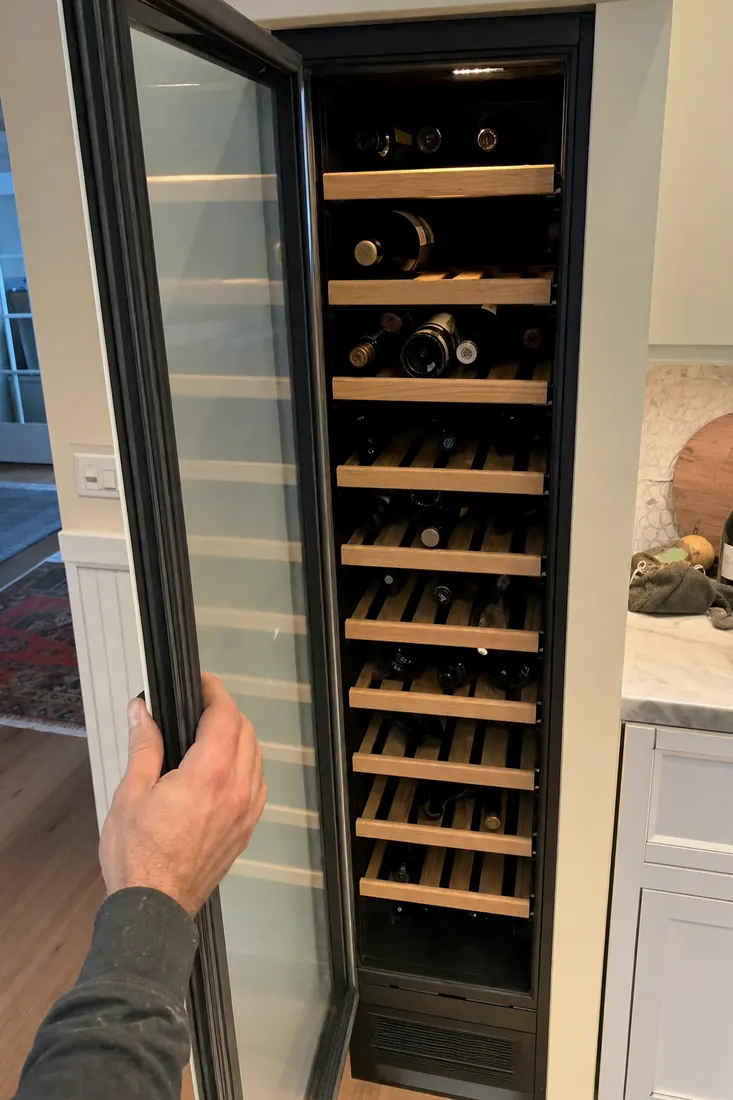
Wine storage, ice machines and undercounter refrigeration
Tighter thresholds, because a new undercounter unit is a real appliance at a real price rather than a five-figure project. Drain, pump, valve, fan and thermostat work is cheap and worth doing. A failed sealed system on a fifteen-year-old undercounter unit is a much closer call than the same failure on a full-size column.
Laundry
Closest of all to ordinary appliance math, because most laundry is not cabinetry-locked. The exception is panel-ready or precisely stacked sets in a closet or under a counter, where fitment reintroduces the built-in problem.
Parts availability is the real deadline
The thing that actually ends a built-in appliance is not wear. It is a critical part that no longer exists.
Ask your repair company three questions about every part on the estimate: is it current, has it been superseded to a new number, or is it obsolete? Supersession is normal and harmless. Obsolescence on a non-critical part is survivable. Obsolescence on the control board, the compressor or the tub is terminal, and a company that tells you so is doing you a service.
Some luxury manufacturers commit publicly to long parts availability windows, and that commitment is a genuine part of what you paid for. It is also the single biggest reason a twenty-year-old built-in is a repair candidate at all when a five-year-old mass-market appliance sometimes is not.
When we say replace
We do say it. The situations are specific and none of them is “it is old”:
- Structural damage to a cabinet, liner or tub.
- Corrosion through the case. Worth checking on outdoor kitchens and coastal installations in Ponte Vedra Beach, Palm Valley, Jacksonville Beach, Neptune Beach, Atlantic Beach and St. Augustine, where marine air works on fins, hinges and fasteners continuously.
- A genuinely obsolete critical part.
- Several unrelated systems failing at once on an aged appliance, where fixing one books the next call.
- A kitchen renovation already underway. The panel, opening and delivery-path arguments all disappear, and the decision genuinely changes.
If you want a straight read on which side of the line yours falls, call +1 (904) 977-8701. We are an independent appliance repair company in Fruit Cove serving St. Johns, Duval and Clay counties. Flat $80 diagnostic, credited toward the repair when you approve the work, and a written estimate before anything is opened — including our honest opinion on whether the repair is worth doing at all.
Step by step
- 01
Get a real diagnosis before you compare anything
You cannot run this math against an unknown fault. A named component and a written estimate is the input. Deciding to replace an appliance whose fault was never identified is how people spend five figures to fix a fifty-dollar valve.
- 02
Measure the opening, and then measure the route
Width, height and depth of the cabinet opening, plus every doorway, stair turn and corner between that opening and the street. On large built-in refrigeration the delivery path is frequently the binding constraint, not the budget.
- 03
Price the replacement fully loaded, not at sticker
Ask the dealer for a quote that includes delivery, installation, removal and disposal of the old unit, any new custom panels or trim kit, and any cabinetry, electrical, gas, venting or plumbing modification the new specification requires. That total is the number to compare against.
- 04
Check parts availability for your platform
Ask the repair company whether the parts in the estimate are current, superseded or obsolete. An appliance whose control board is genuinely unavailable is finished regardless of how good the rest of it is, and an appliance with fifteen more years of parts support is a very different asset.
- 05
Apply the threshold, then check the exclusions
Repair when the estimate is under roughly 40 to 50 percent of the fully loaded replacement cost. Then check the replace-anyway list: structural damage, corrosion through the case, obsolete critical parts, or a kitchen renovation already in progress.
Price bands
What does it cost if this one needs a technician?
Four of the jobs we are called out for most across these appliances. The whole table, and what replacing costs instead, is on the pricing page.
Completed repairParts and labour
| Repair | Typical range |
|---|---|
| Diagnostic visit | $80 |
| Door gasket or seal replacement | $230–$600 |
| Evaporator or condenser fan motor | $250–$610 |
| Defrost heater, thermostat or sensor | $240–$590 |
| Ice maker, water valve or supply line | $240–$630 |
Questions this raises
Does the 50 percent rule apply to built-in appliances?
Not in its usual form. The familiar rule compares repair cost to the price of a new appliance, which works when replacement means unboxing something and plugging it in. A built-in is a cabinetry component, so its true replacement cost includes panels, trim, opening modification, delivery and installation — often several times the sticker price.
What is a reasonable repair ceiling for a built-in?
Roughly 40 to 50 percent of the fully loaded installed replacement cost, with the fraction moving up as the remaining useful life of the appliance goes up. Because the fully loaded number is so much larger than the sticker price on a built-in, that percentage permits far more repair spending than the same rule would on a freestanding appliance.
The part is discontinued. Is that automatically the end?
Not automatically. Ask whether the part is superseded to a current number, available refurbished through a legitimate channel, or genuinely unobtainable. Superseded parts are common and completely normal. A genuinely unobtainable control board on a critical circuit, however, does end the conversation honestly.
Can I just put a standard appliance in a built-in opening?
Usually not without carpentry. Built-in openings are cut to a specific width, height and depth with a finished surround, and panel-ready appliances take custom panels made by a cabinetmaker for that specific door. Discontinued sizes are the real trap — a 27-inch wall oven opening or an obsolete undercounter width often has no modern drop-in equivalent.
When do you tell people to replace instead of repair?
Structural damage to the cabinet, liner or tub. Corrosion through the case, which we see on coastal and outdoor installations. A critical part that is genuinely obsolete. Multiple unrelated systems failing at once on a well-aged appliance. Or a kitchen renovation already underway, at which point the cabinetry argument disappears entirely.
Does the age of the appliance decide it?
No. Age is a fact about the appliance, not a diagnosis. Well-maintained built-in refrigeration routinely runs 20 to 25 years and professional ranges longer than that. What decides it is the named fault, the parts situation, and the fully loaded replacement number — in that order.
If you would rather not